The Application Fabric · The track record
Established Patterns from Other Platform Markets
The problems facing enterprise applications are not entirely new. Other software markets have already addressed different parts of the same architectural challenge.
The track record
Two markets, two takeaways
Commerce platforms learned to coordinate many categories of distributed operational data within a continuous transaction lifecycle. Game engines showed that a shared, high-performance runtime can absorb common technical requirements and let developers focus on the last mile of differentiation.
Neither model maps perfectly onto enterprise technology. Each nevertheless provides a principle the Application Fabric builds on.
Takeaway one
How Commerce Platforms Addressed Fragmented Data
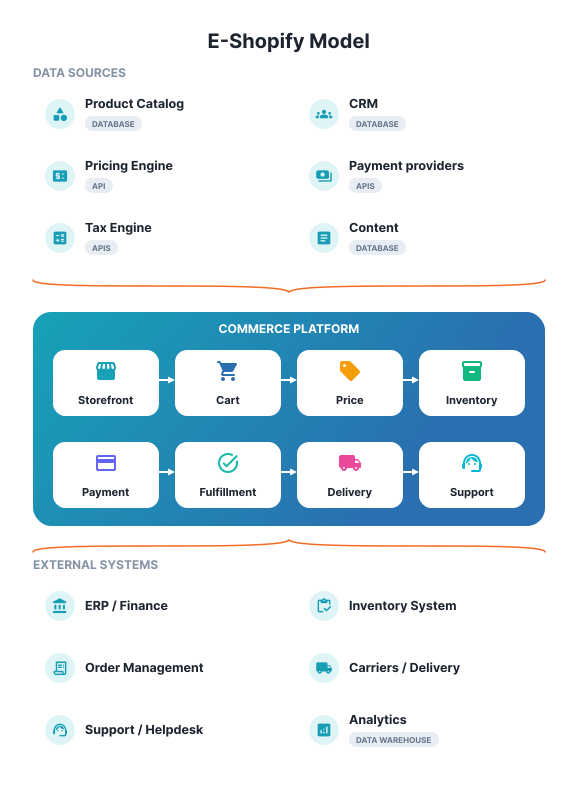
A modern commerce transaction depends on far more than a product page and a payment form. The platform must coordinate product catalogs, inventory, prices, promotions, customer accounts, tax rules, payments, orders, fulfillment, deliveries, returns and third-party logistics. Much of this information is controlled by separate systems and external providers, yet the customer expects the entire process to behave as one continuous experience.
Platforms such as Shopify Plus address this by establishing a common operating layer around the commerce lifecycle. They do not require every participant to use the same database or abandon its own system of record. Instead they provide consistent interfaces, shared objects, event mechanisms and extension points through which the different parts of the process stay synchronized.
This lets a change in inventory affect what can be sold, a pricing rule alter what is displayed, an order initiate payment and fulfillment, and a delivery update flow back into the customer experience. The value lies in the continuity between systems.
Enterprise applications face an equivalent challenge. A trading, risk, logistics or operational workflow may depend on many sources, each with a different owner and technology, and the platform must make them available within one process while preserving their individual authority. The commerce model shows that integration works best treated as a persistent platform capability rather than rebuilt inside every application.
Takeaway two
How Game Engines Enabled Last-Mile Development
Building a modern game requires a large body of sophisticated technology: rendering, physics, animation, input, sound, networking, asset management and deployment, all working together under demanding requirements for concurrency and performance.
Yet most developers do not build these systems. Engines such as Unity and Unreal provide them as a shared runtime, so the developer starts with an integrated set of capabilities and concentrates on the mechanics, content and experience that distinguish the game.
A game engine defines how the software runs, not simply how it is written. It manages data movement, process scheduling, resource allocation, failure handling and the application lifecycle, implemented once and optimized at the engine level.

The same idea, applied to the enterprise
The application engine
Enterprise application development has the same recurring structure. Most operational applications need connectivity, state management, concurrency, event processing, authentication, entitlements, workflow, visualization, reporting, monitoring and deployment. Teams assemble them again for each new application, creating duplicated code, inconsistent controls and separate operating models.
An application engine provides a shared runtime where those concerns are handled consistently and at scale, so applications inherit the same security, performance, monitoring and lifecycle controls instead of managing their own infrastructure. In finance, where systems must process continuous streams, react deterministically and remain auditable, that runtime is not a development abstraction but the long-lived production foundation.
This is the principle of last-mile development: the engine handles what is common, while developers concentrate on the business logic, workflows and user interactions that must be different.
What application engines optimize for
Maximize Quality
Minimize Delivery Time
Maximize Performance
Minimize Cost of Ownership
Maximize Flexibility
Choosing an approach
Comparing Approaches to Software Building
When evaluating how to build and evolve financial software, with engineers or with AI agents, most organizations encounter three broad approaches: packaged vendor systems, custom-built solutions, and application engines. Each reflects a different trade-off between speed, flexibility, control and long-term sustainability.
Vendor solutions offer the fastest path to initial functionality and work well when requirements closely match the product, though customization is limited and integration can be complex. Custom-built systems provide maximum flexibility and ownership, but require teams to design, build and maintain every layer of the stack. Application engines provide a shared, production-grade runtime with reusable primitives tailored to a domain, combining the control of a custom build with the leverage of a platform.
| Dimension | Buy | 3forge App Engine | Build |
|---|---|---|---|
| Flexibility |
Buy · 1/5 Architecture and product direction defined by vendor. Flexibility is limited to configuration. |
3forge App Engine · 5/5 Modular approach where low-value decisions are made by the platform and high-value decisions are available to architects and engineers. |
Build · 5/5 The team builds exactly what is needed. |
| Performance |
Buy · 3/5 Product is optimized for the broadest use cases with limited focus on specific situations. |
3forge App Engine · 5/5 Built for high performance so it can cover all levels of expectations. |
Build · 4/5 The team can optimize for specific use cases but needs to spend considerable resources fine-tuning, monitoring, and maintaining performance levels. |
| Low total cost of ownership |
Buy · 3/5 Cost tied to the vendor's commercial terms, still often less expensive than in-house development. |
3forge App Engine · 4/5 Substantially accelerates delivery and compounds benefits as use cases grow. |
Build · 1/5 Admittedly the most expensive approach to build software during build and maintenance phases. |
| Best used for | Use when the workflow is not a differentiator and needs are not unique within the industry | Use to facilitate your core business and drive your differentiator | Use for your core business as your differentiator |
The Application Fabric
3forge is inspired by what worked in these industries.
See how we applied these approaches to build a finance-oriented application fabric.