Live Data
A unified data fabric where live market feeds, intraday events, and resting data from warehouses and legacy platforms converge: governed, queryable, and ready for real-time decision-making.
The data foundation
Where live feeds and resting data converge
In financial institutions, data is never purely "real-time" or purely "historical". Risk, trading, compliance, and operations all depend on the continuous interaction between live market feeds, intraday events, and vast stores of resting data held in warehouses and legacy platforms. Treating these sources as separate domains creates artificial boundaries that slow decision-making, complicate architectures, and introduce operational risk. As a result, finance increasingly expects a single, coherent data layer where live and historical information can be accessed, queried, and acted upon as one.
Live data, in this context, means a unified access point that intersects streaming and resting datasets across feeds, databases, and legacy infrastructures, governed by entitlements and security policies. This data layer is not passive: it enriches raw data with business logic through complex event processing, enabling systems to detect conditions, aggregate signals, and react deterministically as events unfold. It then makes the data available to users and agents through many integrations and interfaces, from real-time dashboards and reports to streams into Python, ODBC, and C++ applications. In finance, such a live data foundation is no longer a differentiator: it is a prerequisite for building systems that are responsive, auditable, and fit for real-time decision-making.
Consuming data and virtualizing access
With over 35 database adapters and 15 feed adapters, 3forge can consume real-time and resting data from virtually any source, and present it as a unique access point to data consumers. By insulating downstream apps from idiosyncratic data formats, 3forge accelerates project deployments, implements explicit access control, and performance management. Once in 3forge, the data can be queried via the REST API, JDBC, ODBC, MCP, as well as through bidirectional libraries in .Net, Python, Java, and RPC between the 3forge Relays and external systems.
Whether the data is consumed by users on UI screens, PDF and email reports, AI language models, or third-party applications, 3forge can mesh different datasets, augment them with derived analytics updated as data changes, and protect them with granular entitlement.
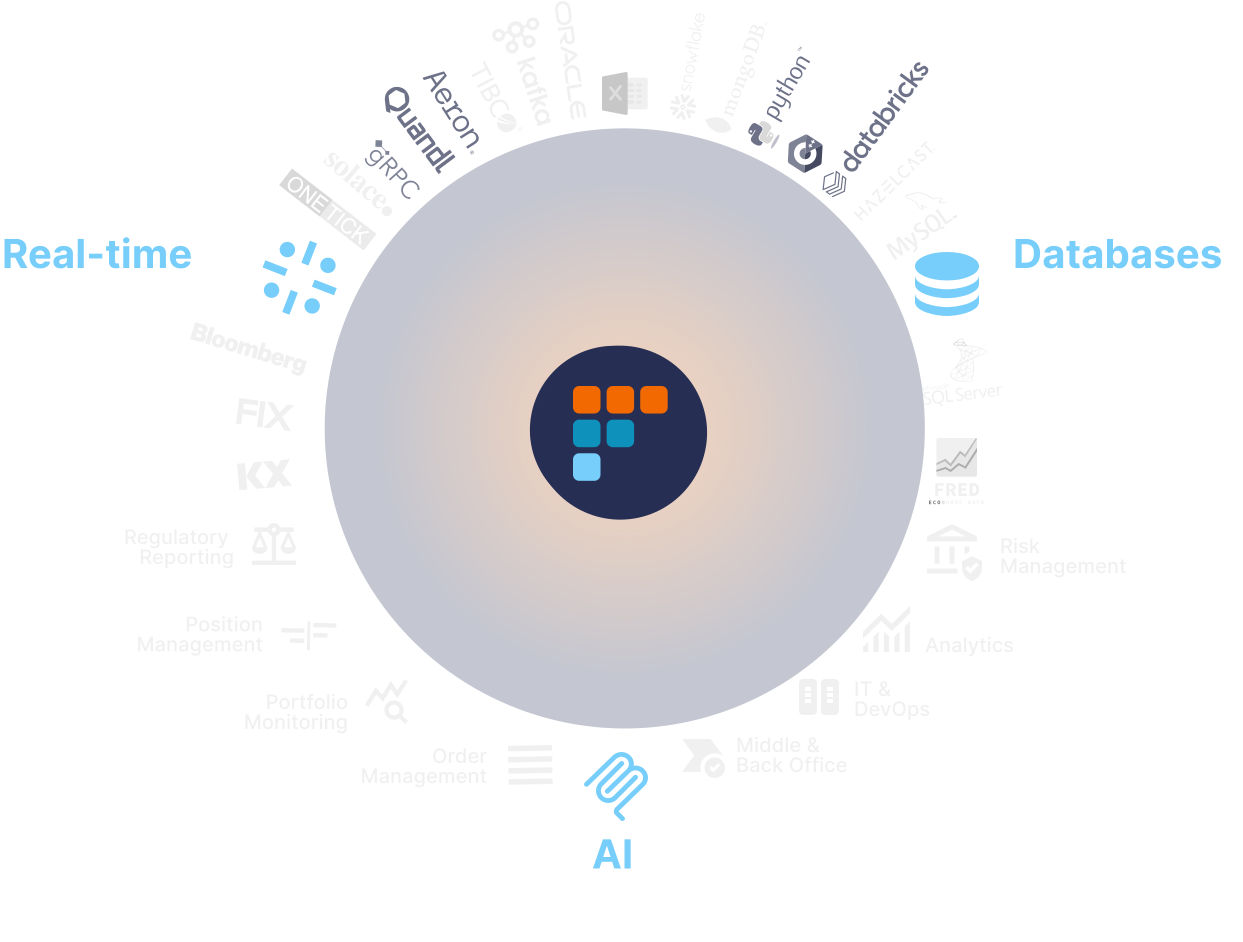
Supported Database Adapters
- AMI DB
- Flat File
- AMI Shell
- Excel
- Fred
- Quandl
- Oracle
- Msft SQL
- MySQL
- Apache Spark
- SAP Sybase
- SybaseIQ
- KX
- Hadoop
- Mongo DB
- R
- Impala
- PostgreSQL
- Phoenix
- Chronicle Queue
- Netezza
- MemSQL
- Couchbase
- SQLite
- REST API
- Snowflake
- Hazelcast
- IBM DB2
- Greenplum
- Symphony
- HP Vertica
- Hive
- Deephaven
- Bloomberg
- Apache Ignite
- Redis
Supported Feed Handlers
- SingleStore
- Solace
- Tibco
- RabbitMQ
- KX Stream
- Chronicle Queue
- IBM MQ
- OneTick
- FIX
- Amazon SQS
- Aeron
- Kafka
- ActiveMQ
- 60 East-Amps
- BPIPE
- QuantHouse
- Google RPC
Programmatic Access
- REST API
- JDBC
- .NET
- Python
- Java
- ODBC
- Google RPC
- C++
- MCP
Real-time and historical tables
With its proprietary columnar database, 3forge delivers industry-leading analytical flexibility for streaming and time-sensitive workloads, including Real-time Tables (RDB) and Historical Tables (HDB). 3forge adds unique features that address difficult data problems that software engineers encounter.
Real-time streaming analytics
Delta-based triggers provide fast and efficient aggregations, joins, projections, and more.
DocsIntuitive yet comprehensive language
The combination of a Java/.NET syntax with SQL and Python.
DocsReplication and scalability
Enable replication, processing sharding, and web load-balancing without additional code.
DocsStreaming to historical tables
Support for streaming inserts into historical tables with immediate consistency.
DocsAdvanced conflation
Consume data at exponential rates and down-sample for downstream consumers.
DocsREST admin and query APIs
Automate monitoring and support activities, and create custom endpoints.
DocsNo-fuss historical table schema changes
Alter schemas instantly without the need to backfill data.
Docs3forge Database Operational Envelope
capacity (rows)
columns
(ops/sec)
latency
How much is 10 trillion rows?
The consolidated feed for equity trades and quotes on US markets, or SIP, has ~2.5 billion SIP messages per trading day. If 1 row is 1 consolidated SIP message (trades + quotes), 10 trillion rows would represent 4,000 trading days, or 16 years. Similarly, options market data is extremely dense at ~200 billion quote updates per day on OPRA during active markets. Even at that frantic pace, 10 trillion quote updates would be 2.5 months of option quotes traffic.
Real-time data aggregation
The 3forge platform is particularly well-suited for time-sensitive, large-scale data transformations and comparisons. Its inherent modularity allows for a broad array of deployment configurations that can be tailored for each specific use case. In addition, the pricing model of 3forge proves particularly beneficial for companies needing substantial scalability and flexibility while keeping costs predictable and affordable.
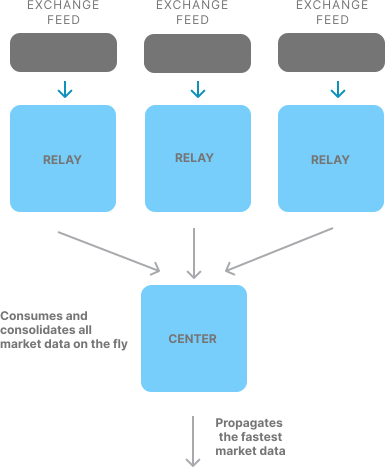
A 3forge Center can receive market data from different feeds, reconcile the streams in real time, and propagate the fastest price to downstream systems. These exchange feeds may be split between data centers for additional redundancy.
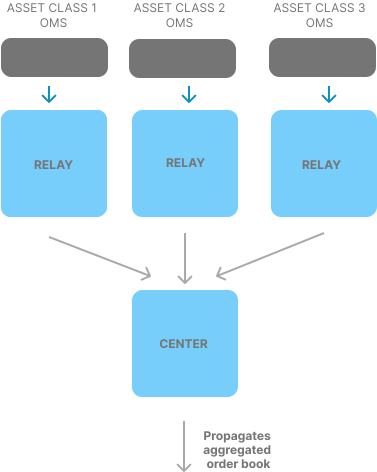
Similarly, a 3forge Center can receive orders from different order management systems representing asset classes or market access pathways, including no-touch and low-touch order flow, and aggregate them to achieve a unified representation of market activity for transparency, risk management, exposure control, and even internal order crossing.
Optimizations for the largest data loads
3forge leverages several advanced approaches to balance the need for speed in data transmission with technical constraints that could slow down the data flow.
Delta-based processing
Rather than reprocessing or retransmitting the entire dataset each time an update occurs, 3forge only handles changes (deltas) in the data. This approach dramatically improves performance and efficiency in real-time systems.

Conflation
When replicating data across its tiered architecture, 3forge can be configured to send every update or instead send the latest one on an agreed interval. This effectively discards intermediate values, dramatically reducing the burden for downstream consumers.

Summarization
3forge can calculate and store regular and delta-based summary metrics, including averages, sums, counts, mins, or max values, to compress data volumes, allow for trend analysis, and support time-based analytics like moving averages.

Decoration
3forge supports automated data decoration through event-driven triggers invoked during data operations, enabling dynamic enrichment, validation, and propagation of data in response to table-level changes.
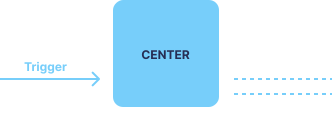
Complex event processing
3forge offers real-time tables and database-native functionality to allow business logic to be executed on the fly based on data updates. In combination with conflation, these triggers can smartly and efficiently process only as much work as needed.
The following trigger types are supported out of the box:
Aggregation
Create and update aggregation tables as source data changes.
Projection
Maintain automatically filtered or transformed projection tables.
Join
Create and keep joined tables synchronized across source updates.
Decorate
Enrich the data with additional fields from another table.
Relay
Send messages to downstream systems through the 3forge Relay.
AMIScript
Run custom scripts upon any insert, update, or delete activity.
Trigger syntax reference
Script trigger
Create trigger <trigger_name>
Oftype Amiscript
ON <table_name>
[PRIORITY priority]
Use...
Aggregation trigger
Create trigger <trigger_name>
Oftype Aggregate
ON <source_table>,
   <target_table>
Use...
Projection trigger
Create trigger <trigger_name>
Oftype Projection
ON <source_tables>,
   <target_table>
Use...
Petabyte historical database for archiving
While the highest query performance is achieved with real-time databases, 3forge also offers columnar historical tables capable of holding trillions of rows. Persisted to disk and supporting partitioning, these tables are designed for storing large volumes of data at high speed with fast retrieval, all while using the same SQL syntax as real-time tables.
Data from historical tables can be queried and loaded into a real-time table where the full breadth of querying optimizations can be accessed, including joins with other tables.
3forge uniquely supports the following features in its Historical database (HDB):
Large column counts and heavy data types
Support for large column counts and heavy data types including blob fields, without compromising query performance or storage efficiency.
Configurable storage strategies
Configurable storage strategies for each column, including four storage types for optimal performance. The system dynamically adapts storage types during optimization on a partition basis for disk efficiency and query speed based on actual data usage.
| Type | Description |
|---|---|
| FLAT | Fixed-length types like INT, FLOAT, DOUBLE |
| VARSIZE | Variable-length types like STRING and BINARY, up to 1 TB |
| BITMAP | Efficient for low-cardinality strings |
| PARTITION | Organizes rows into isolated partitions |
Schema management
Add, drop, or modify columns without impacting historical partitions. Partition columns are immutable, so careful planning is essential when designing the table schema. HDB ensures older partitions are mapped to new schemas seamlessly, preserving historical integrity.
Row-level operations
HDB supports UPDATE and DELETE clauses while preserving partition optimization. Significant changes within a partition are re-optimized automatically. Sort indexing further enhances query performance.
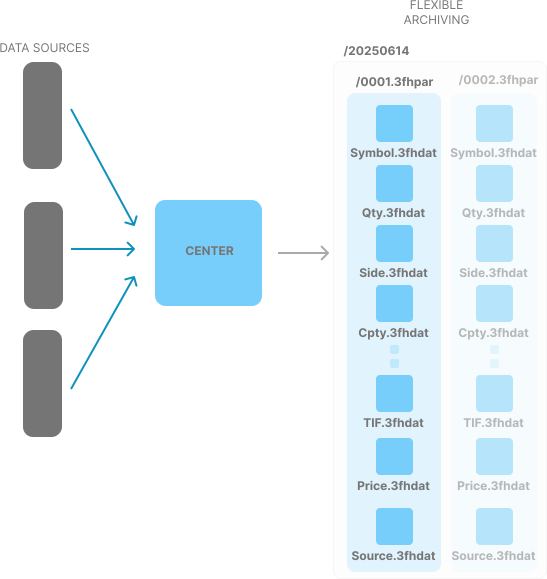
Archiving real-time data from streaming updates
Seamlessly move data from real-time tables into HDB using event, batch, or timer-driven approaches. This ensures historical records remain up to date without interrupting ongoing operations.
Reliable data scaling
When processing and archiving high-velocity datasets, 3forge makes improving performance and resiliency straightforward and safe.
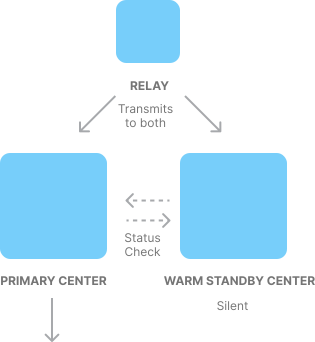
Database replication
3forge delivers simple and effective data replication between primary and warm standby Center databases with a simple configuration. The standby can check for the health of the primary and take over in case of failure with all the data already loaded in memory.
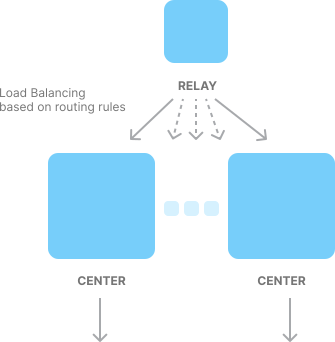
Database load-balancing
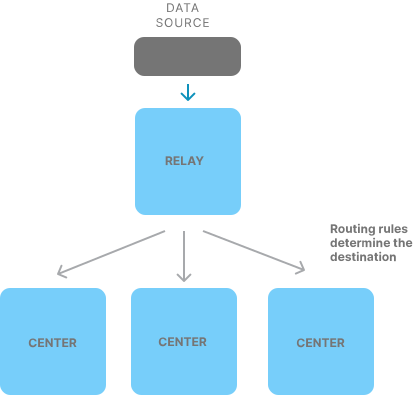
Replication can also be used for load balancing between multiple Centers based on routing rules in the Relay. These multiple Centers increase redundancy and scalability. The flexibility of the platform allows for more advanced deployments, such as multi-region and even global replication.
Global infrastructure resiliency
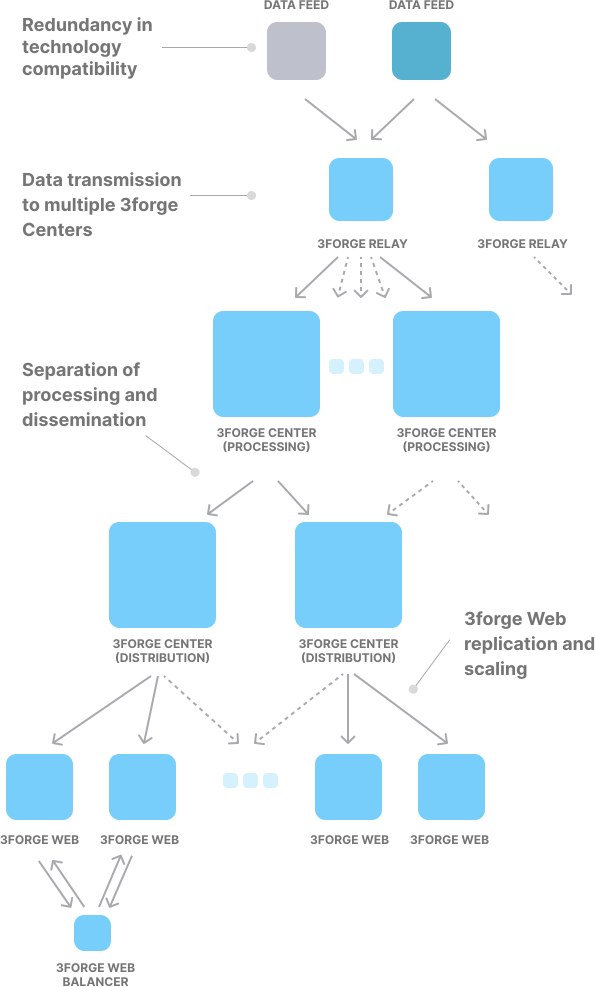
Every aspect of the tiered 3forge architecture can implement data replication for redundancy and resiliency.
Diversity of feed and data source adapters
Allow data to be sourced and archived to and from remote systems.
3forge Relays
Can disseminate data to multiple Centers for hot-hot and hot-warm redundancy scenarios.
3forge Centers
Can be configured together to distribute work or provide hot or warm standby.
3forge Web components
Able to connect to multiple centers and support distributed user profile management.
3forge Web Balancer
Allows for use of multiple webs with a single IP address, routing users based on available Web capacity.
Dynamic message routing & map reduce
3forge enables dynamic routing rules that intelligently dispatch messages to specialized processing centers based on content, load, or custom logic, all configurable in real time. Each center can independently process its portion of the workload before the results are seamlessly merged through a map-reduce operation. This architecture ensures optimal resource utilization, parallel processing, and high-performance aggregation across distributed systems.
Guaranteed messaging
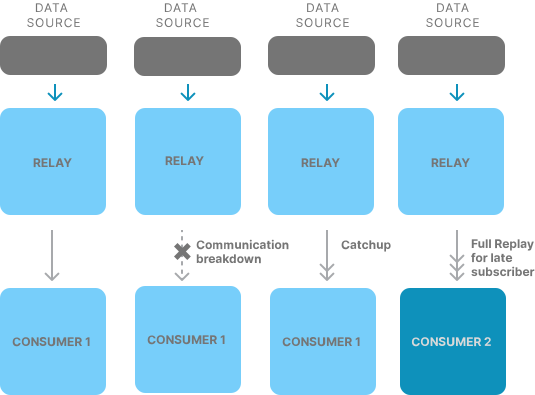
Guaranteed messaging ensures that every critical update is durably persisted and delivered reliably, regardless of system load or transient network conditions. Messages are journaled to a write-ahead log (WAL), allowing downstream centers, including those temporarily offline, to recover and replay missed data upon reconnection. While guaranteed messaging does not perform duplicate suppression, it provides the durability and continuity required for real-time trading, risk, and compliance systems.
Message transformation and routing
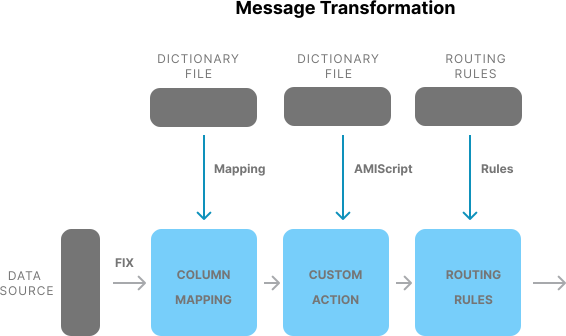
3forge includes powerful message transformation capabilities, allowing firms to inspect, modify, enrich, or filter messages in-flight, all without writing custom code. This is especially valuable for FIX and other financial protocols, where dynamic adjustments may be required to support different counterparties, normalize formats, redact sensitive fields, or route based on content. With support for declarative rules and scripting, 3forge enables rapid, flexible logic tailored to evolving trading and compliance needs.
See Live Data handling your most demanding feeds.