Horizontal Scaling
Web Balancers
Web Balancers route users across a Web tier that grows by adding nodes, not by reworking each application.
Function inside the fabric
One entry point in front of many Web Servers
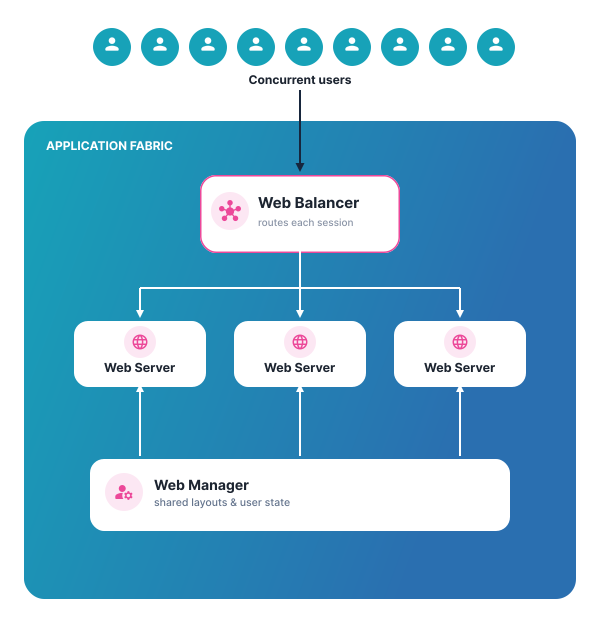
As concurrent sessions grow, adding Web Servers scales the application tier horizontally. A Web Balancer is a platform-aware entry point that routes users among them, so no application has to implement distribution logic of its own.
A single-node deployment and a large Web estate are then operated the same way: capacity is a question of how many Web Servers are running, not of how each application was built.
Capabilities
What a Web Balancer provides
A platform-aware entry point
- Session routing across Web Servers
- One address in front of the tier
- No distribution logic per application
Capacity that grows by node
- New Web Servers add capacity
- Thousands of concurrent users
- The same deployment model at any size
Consistent sessions
- Shared layouts from the Web Manager
- Preferences follow the user
- Routing does not change what a user sees
Working together
The Balancer picks the server, the Manager gives it the state
The Balancer determines which Web Server handles a session. The Manager ensures that server has the right application and user state. Together they carry large user populations across the Web tier without turning each Web Server into an independently managed environment.
Both operate inside the institution's own network architecture, so application-aware Web scaling is solved once for the platform rather than once per deployment.
Observability and management
Scaling the Web tier is one problem. Seeing the whole estate is another.
Operations Hub catalogs deployed applications and their instances, monitors health and utilization, and reports on versions and licensing.